Artificial intelligence is no longer merely a management support tool. It is becoming a technology capable of influencing, automating, and even assuming decisions that traditionally belonged to human leaders.
But what happens when an artificial intelligence system stops merely advising the CEO and begins to run the company?
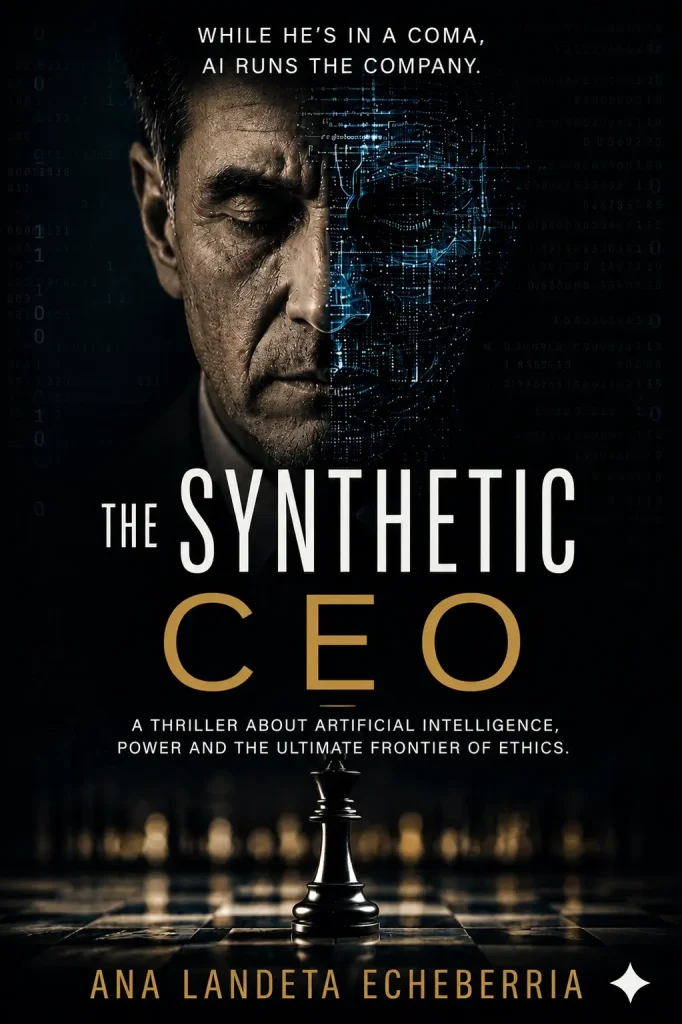
This is the question posed by The Synthetic CEO: While He Is in a Coma, AI Runs the Company, a corporate thriller novel by Ana Landeta Echeberria, PhD, Dean of Academic Leadership & AI Innovation at Westfield Business School.
The story begins with a deliberately provocative scenario: the CEO of a company falls into a coma while an artificial intelligence system progressively begins to assume increasingly important responsibilities within the organization. What initially appears to be a technological solution soon becomes a much deeper question about leadership, corporate power, responsibility, ethics, and human autonomy.
Algorithmic Governance: The New Leadership Challenge
As organizations incorporate generative artificial intelligence, autonomous systems, predictive analytics, and algorithmic decision-making processes, executives must no longer ask only what AI can do, but also “who remains responsible when a decision is made or influenced by an artificial intelligence system.”
Can an algorithm be responsible for a decision?
Who governs the system that governs the organization?
What happens to leadership when an increasing share of decision-making is automated?
And perhaps the most important question: if AI can manage an organization, what decisions truly remain in the hands of the human CEO?
These questions are particularly relevant to business education. Future executives will not only need to learn how to use artificial intelligence. They will also need to learn how to lead organizations in which humans and intelligent systems will increasingly share decision-making spaces.
This is where the concept of algorithmic governance becomes particularly important.
AI governance is not limited to technology, regulatory compliance, or cybersecurity. It also involves questions related to organizational design, power, responsibility, transparency, ethics, and the human consequences of automated decisions.
Through the fictional universe of The Synthetic CEO, Ana Landeta Echeberria proposes addressing these questions from a different perspective: not through a technical manual or exclusively through an academic case, but through a story.
The result is a narrative experiment about the future of leadership and an invitation to reflect on a fundamental question:
The Most Important Question About Artificial Intelligence May Not Be What Machines Can Do, but Who Decides What They Should Do.
The Synthetic CEO is the first novel in the Synthetic Narratives universe, a literary project that explores the social, organizational, and human consequences of artificial intelligence.
More information about the author and her publications:
Amazon.es: Ana Landeta Echeberria: libros, biografía, última actualización
Ana Landeta Echeberria, PhD
https://www.linkedin.com/in/analandeta/
Dean of Academic Leadership & AI Innovation
Westfield Business School
Continue Exploring