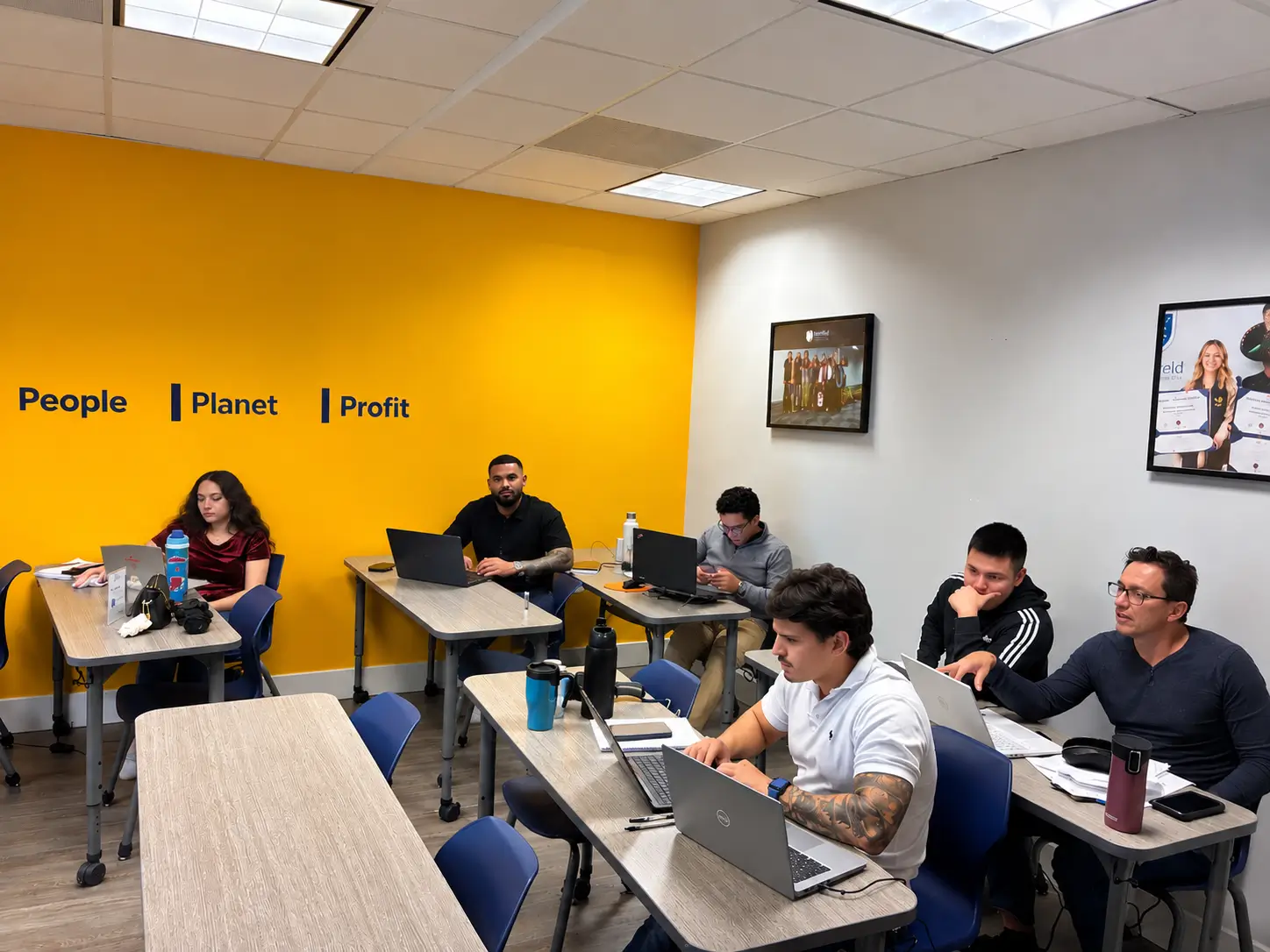

Artificial intelligence adoption in the corporate environment is no longer a promise for the future but an everyday reality. Virtual assistants, generative models, and integrated automations are becoming increasingly common across organizations.
However, many companies have begun using AI without first defining the rules of the game: what happens when the system fails, discriminates, or makes the wrong decision?
At Westfield’s Keynote on September 2, 2026, Dennis Kirpensteijn, founder of Voltaire, addressed this issue from a central premise: responsible AI is not merely a technical matter. It is a question of leadership, culture, and organizational accountability.
The question that opened his presentation summarizes it clearly: who is responsible when AI makes a mistake?
The Air Canada Case: The Company Is Responsible
To illustrate the risks of implementing AI without clear rules of responsibility, Kirpensteijn presented the Air Canada case.
A customer asked about a flight discount on the airline’s website. The chatbot provided incorrect information and, when the customer filed a claim, the company argued that the chatbot was responsible for its own responses.
The tribunal did not accept that argument. As explained in the keynote presentation, the company is responsible for what it communicates through its website, including information provided by its AI.
The lesson presented by Kirpensteijn goes beyond a technological failure: there was a gap in accountability. No one had defined who was responsible for what the machine said.
Ethics and Culture: Beyond the Discourse
Many organizations can establish principles for the ethical use of technology. But in Kirpensteijn’s framework, ethics must become a practice.
Every principle must translate into concrete decisions: what is done, what is not done, and who decides. If a principle does not change any decision, it remains a statement without practical application.
Culture plays an equally important role. In the context of AI, this means establishing the rules before putting a system into operation, rather than improvising them after something goes wrong.
The Control Point: Decide, Approve, or Review
One of the practical elements addressed during the keynote is determining at what point a person intervenes.
Kirpensteijn presents three possibilities:
- The person decides: AI provides material, but the decision is made without it.
- The person approves: AI produces or drafts the output, but an identified person approves it before it is released.
- The person reviews: AI performs the work, and a person subsequently reviews it and documents that oversight.
The issue, therefore, is not merely to state that human oversight exists, but to determine where it occurs and who is responsible for exercising it.
The AI Governance Canvas: A Practical Tool
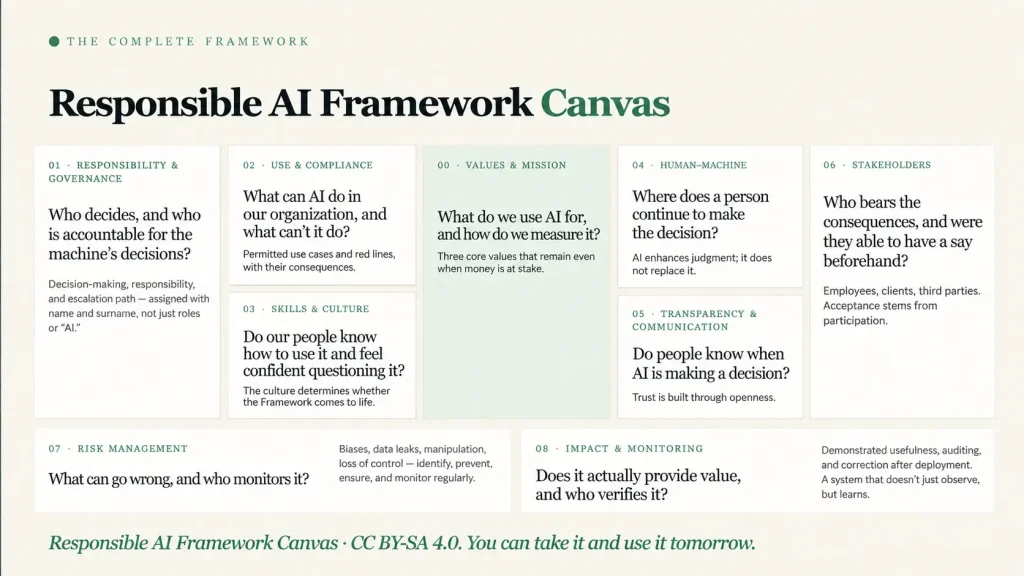
The Responsible AI Framework Canvas brings this reflection into a practical framework for organizations.
Rather than approaching AI governance solely from a technological perspective, the Canvas raises questions related to responsibility, use and limits, values and mission, competence and culture, the relationship between people and machines, transparency, stakeholders, risk management, and impact and monitoring.
The objective is to move responsibility from a general statement toward concrete decisions within the organization.
Nine Questions That Support the Decision
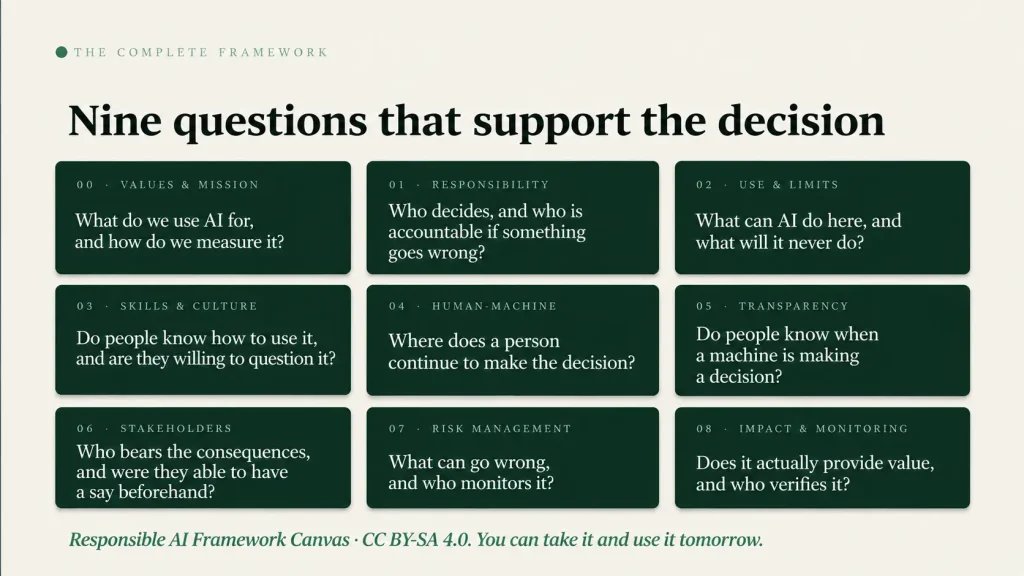
The framework presented by Kirpensteijn organizes the conversation around nine questions:
Values and mission: What do we use AI for, and how do we measure it?
Responsibility: Who decides, and who is responsible if something goes wrong?
Use and limits: What can AI do here, and what will it never do?
Competence and culture: Do people know how to use it, and are they willing to question it?
People and machines: Where does a person continue to make the decision?
Transparency: Do people know when a machine is making a decision?
Stakeholders: Who bears the consequences, and were they able to provide input beforehand?
Risk management: What can go wrong, and who monitors it?
Impact and monitoring: Does it actually provide value, and who verifies it?
These questions help move the conversation about responsible AI from general principles to concrete decision-making situations.
Responsible AI Is a Leadership Decision
Artificial intelligence opens new possibilities to support, automate, and expand capabilities within organizations. But its adoption also requires defining purpose, boundaries, and responsibility.
The conclusion of the keynote summarizes this idea:
“Responsible AI is not decided in systems. It is decided by leadership.”
And it begins with a deeply human question: who is responsible?
Dennis Kirpensteijn
Founder, Voltaire
https://www.linkedin.com/in/denniskirpensteijn
Continue Exploring
Continue Exploring AI and Leadership: When Algorithms Begin to Govern | Methodology | Programs